An attention check question is a survey item designed to help identify respondents who are not reading or answering carefully. A well-designed check has a clear, unambiguous expected response and tests attention, not a respondent’s knowledge, memory, or agreement with the researcher. Used alongside other quality signals, attention checks can help protect survey data quality without automatically excluding people who make one mistake.
Types of attention checks at a glance
Attention checks in surveys range from direct instructions to behavioral patterns. No single type provides a definitive verdict: the same response can reflect inattention, misunderstanding, accessibility needs, or a genuine change in opinion.
| Check type | What it tests | Example | Risk of false positives |
|---|---|---|---|
| Instructed response item (IRI) | Whether the respondent follows a direct instruction | “Select ‘Somewhat disagree’ for this item.” | Low to moderate if the instruction is clear and visible |
| Instructional manipulation check (IMC) | Whether the respondent reads and follows a longer instruction | “To show you’re reading, skip this question and continue.” | Moderate; complex wording can be misread |
| Bogus or obvious item | Whether a response conflicts with a highly unlikely or clearly stated fact | “I have personally visited the moon.” | High if it tests knowledge, humor, or interpretation |
| Red herring or nonsense item | Whether the respondent reacts to an irrelevant or incoherent prompt | “Which color tastes most like Tuesday?” | High; respondents may reasonably interpret it differently |
| Reverse-worded item | Whether answers are consistent across related statements | Pair positive and negative statements about the same experience | Moderate; reverse wording can confuse respondents |
| Behavioral or paradigm check | Whether response behavior suggests low effort | Unusually fast completion, straightlining, or an incoherent open end | Moderate to high unless combined with other evidence |
A review of attention-check research recommends clear items with one intended answer and cautions against checks that measure knowledge or impose unnecessary cognitive effort (Muszyński, 2023). That distinction matters: the goal is to identify questionable data, not to test respondents.
12 attention check questions examples
These examples are designed to adapt. Replace bracketed text with content that fits your survey. Examples marked Avoid illustrate checks that can create misleading failures.
Direct instructions and attention items
1. Simple instructed response: good
For this question, please select “Somewhat disagree.”
Use a visible, single instruction and ensure the answer option appears exactly as written. This is a straightforward IRI.
2. Embedded scale instruction: good
Thinking about your recent experience, how satisfied are you with the service?
Please select “Neither satisfied nor dissatisfied” for this item.
This can sit among similar rating questions. Keep the instruction easy to distinguish from the actual scale prompt.
3. Instructional manipulation check, use sparingly
This item is a quality check. To continue, please leave this question unanswered and select “Next.”
This tests whether someone follows a multi-step instruction. Make sure the survey platform allows the respondent to continue without answering. Long or complicated IMCs may measure comprehension as much as attention.
4. Knowledge-based “obvious” item, avoid
The Earth is generally recognized as round. Do you agree or disagree?
A person could fail because they interpret the statement differently, respond playfully, or object to its wording. It tests more than attention, so don’t use failure as grounds for exclusion.
Bogus, red-herring, and consistency checks
5. Nonsense prompt, avoid as a pass/fail check
Which color tastes most like Tuesday?
There is no objectively correct answer. A response may be playful rather than inattentive, making this a poor basis for flagging or excluding a respondent.
6. Fictional brand, use cautiously
Which of these brands have you purchased in the past 30 days?
[Brand A] / [Brand B] / [Fictional Brand] / None of these
A fictional option can appear to be a bogus item, but respondents may select it by mistake or misunderstand the list. If you use one, treat it as a weak signal and avoid making it the sole exclusion criterion.
7. Reverse-worded substantive item: consistency signal
Overall, I found it difficult to complete my most recent order.
Pair this with a clearly related positive statement, such as “Overall, placing my most recent order was easy.” Reverse-score the item during analysis and inspect inconsistent answers; don’t assume a mismatch proves inattention.
8. Repeated-item consistency check, investigate, don’t auto-fail
Earlier: “How often did you use the app last week?”
Later: “In the past seven days, how often did you use the app?”
A large difference can prompt review, but recall and interpretation may vary. Keep time frames and wording as comparable as possible.
Behavioral checks
9. Response-time check, flag for review
[Use a normal survey item, such as: “How satisfied are you with your most recent purchase?”]
Record the time spent on the item or page. Compare it with the time needed to read and answer, not just a universal speed cutoff. A fast response can be a signal, but it is not proof of careless responding.
10. Straightlining check, inspect the response pattern
Please rate each aspect of your latest experience:
Product quality / Ease of use / Customer support / Value for money
Scale: Very poor / Poor / Fair / Good / Very good
Identical answers across a matrix may indicate straightlining, but consistent ratings can also be genuine. Consider the number of items, response times, and any contradictory answers before flagging.
11. Open-ended coherence check, review the content
In one or two sentences, what is one thing you would improve about your most recent experience with [product/service]?
Check whether the response is relevant and intelligible, not whether it matches a preferred opinion. A blank, copied, or unrelated answer may warrant review alongside other quality indicators.
12. Blank instructed response: test carefully
Please leave this question unanswered, then select “Next” to continue.
This can detect whether someone follows an instruction to provide no answer. Test it on mobile and with accessibility settings, and confirm that the survey does not require a response to proceed.
For a broader discussion of screeners and their properties, see Berinsky, Margolis, and Sances (2019).
Where to place checks, and how many to use
Avoid placing a check as the survey’s first question or its final item. Respondents need a chance to understand the survey, and a check at the very end provides little opportunity to investigate a quality concern while the response is in progress. Instead, spread a small number through the survey, after the opening and before the closing section.
For a typical 10-minute survey, start with two clear checks, spaced apart. Consider a third only when the study’s risk, length, or use case justifies it. Vary the format rather than repeating the same instruction. Too many checks can frustrate attentive respondents and make a survey feel like a test. If you need to assess respondents before treatment assignment, plan that timing explicitly and consider how screening may affect the sample.
How to score failures without overcorrecting
Set the decision rules before fieldwork and separate flagging from termination or exclusion:
- Flag for review: One missed check, an unusually fast response, or a straightlined grid by itself.
- Consider exclusion: Multiple independent warning signs, for example, two failed checks plus extreme speed and an irrelevant open-ended response.
- Terminate in progress: Reserve this for pre-defined cases where continuing would undermine the study, and pilot the rule first.
A failed check is not a diagnosis. Research has found that some respondents fail instructed-response items deliberately, while others may misunderstand them (Silber, Roßmann, and Gummer, 2022). Review the full response, check whether the item was clear on different devices, and assess the impact of exclusions on sample composition. Don’t delete data blindly or make a decision based on one item alone.
Attention checks are only one layer of survey data quality
Attention checks do not reliably identify every bot or low-quality response. Combine them with device and browser fingerprinting, near-duplicate detection, speed checks, straightlining review, and open-end assessment. Each signal has limitations; their value comes from a considered review of the pattern across a response.
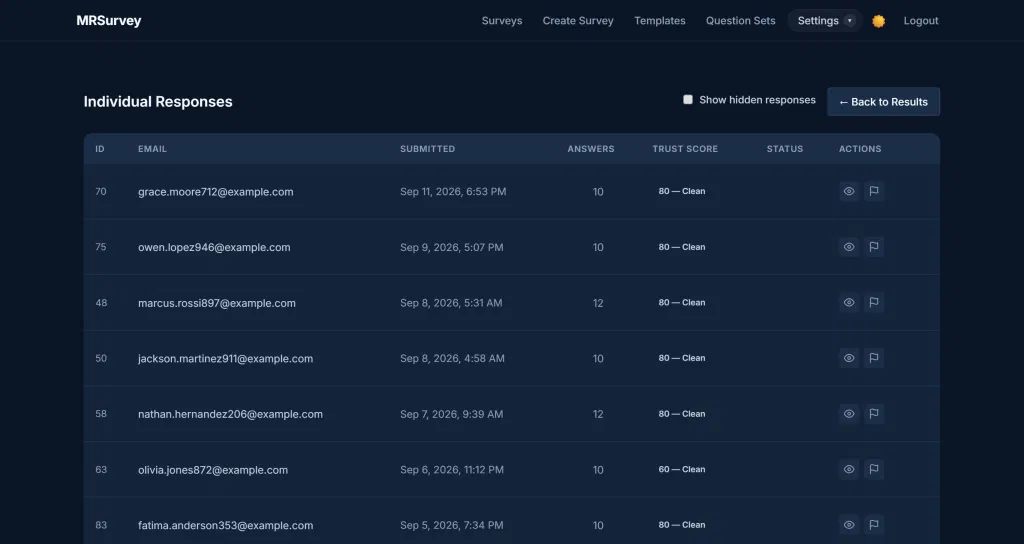
MRSurvey includes built-in respondent quality checks such as device/browser fingerprinting, near-duplicate detection, and automated response flagging. Researchers can use respondent quality management and duplicate detection to review signals alongside attention-check results.
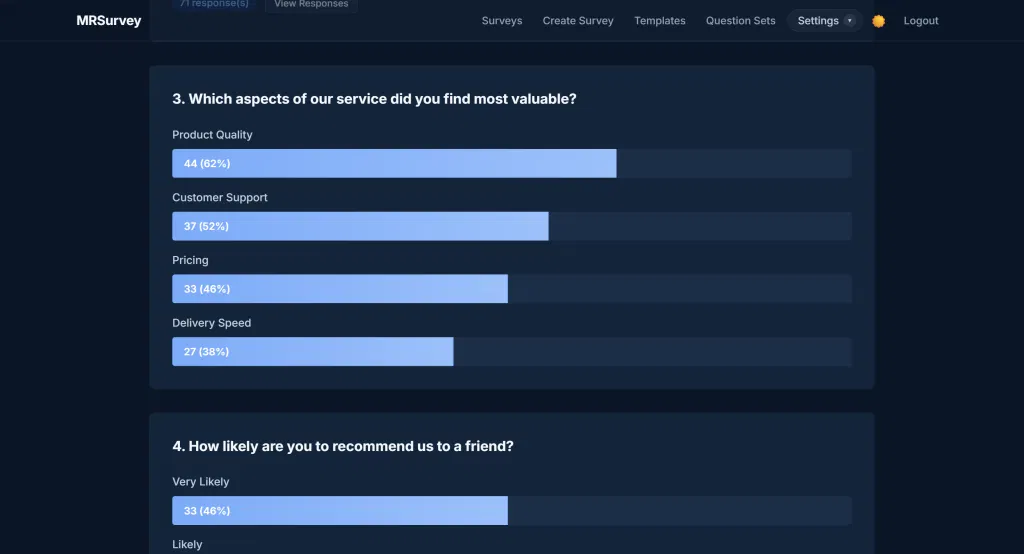
MRSurvey’s real-time analytics supports response-level review, charts, cross-tabs, and analysis of flagged responses. That makes it easier to investigate suspicious patterns before deciding how to handle them.
Frequently asked questions
How many attention checks should a survey have?
There is no universal number. For a 10-minute survey, two well-designed checks spaced apart are a practical starting point; add another only if the research risk or design calls for it. More checks are not automatically better and can frustrate respondents.
Should I exclude anyone who fails an attention check?
No. A single failure can reflect misunderstanding, a display issue, or a genuine mistake. Use failures as a flag and assess them alongside other evidence (such as response time, straightlining, and open-ended coherence) before deciding whether a response should be excluded.
Do attention checks detect survey bots?
Not reliably on their own. A bot may pass a simple instruction, while a human respondent may fail one. Combine attention checks with technical signals such as device/browser fingerprinting and near-duplicate detection, plus behavioral review.
Are reverse-worded questions attention checks?
Not by themselves. Reverse-worded items are primarily used to assess response consistency and require careful interpretation. Confusion over negative or reversed wording can create apparent inconsistencies, so they should not be treated as definitive proof of inattention.
Key takeaways
- Use clear checks with one intended response; avoid knowledge tests and confusing tricks.
- For a 10-minute survey, begin with two checks placed apart, not at the very start or end.
- Treat a failed check as a signal to investigate, not an automatic reason to exclude.
- Combine attention checks with technical and behavioral quality indicators.
- Review the full response and document exclusion rules before fieldwork.
